Showing posts with label AmigaOne. Show all posts

Tuesday, 14 August 2018

Interview with Paul Rezendes

1. Hello and welcome from us at BlitterWolf. For our readers could you tell us your name, country and occupation please?
A. My Real name is Paul Rezendes and I am from the USA. My current occupation is with the US Department of Defense where I am an Engineering Technician with the Navy. Its a civilian position and I do a lot of support work for several Navies other than just the US Navy. Before that I worked as a Technician at Intel working in R&D. I also served in the United States Navy from 1991 through 2012.

2. When did you initially conceive the A4000 Replica board and the reason behind it?
A. I first thought of doing this project after seeing the A1K project red A500+ they did. I just didn’t know how I would be able to fund it. As many know I also do a lot of repair work and restorations of Amiga boards and peripherals. I’ve often thought it would be so much easier to replace a dead 4000 Rev B with a new board and transfer the good parts over to it. I am not a designer myself and haven’t done anything as complicated as a complete motherboard, only a few small projects that have been quite simple. The real spark that set this project in full motion though was the preview Hese showed off at Amibay and then started selling his 4000CR board. The day I first saw that board was the day I started the project funding page.
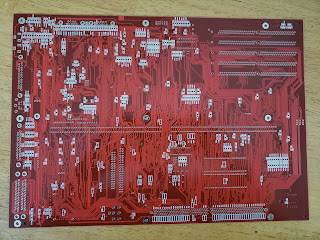

ACILL Motherboards
3. What is your drive behind continuing with the A4000 Replica project?
A. My real drive is to have a good foundation to have 4000 Rev B boards available for use in repairs. A lot of the dead machines are from the battery leaking and taking out some very tight traces and key parts that make the 4000 function. It takes way too long to repair these and make any real money from it. Many people know my motivation isn’t to make money off this work and more to save machines. The next step is to take the newly released data and hope someone with the skill can update the schematic design and recreate the 4000 into a more modern form factor to allow better cases and even more features. Everything needed to do that is now released and possible. We just need someone to take up the project and run with it!

4. Accelerators always seemed popular in the Amiga community, how do you feel the Amiga community have reacted to your reverse engineered board?
A. With very few exceptions I have had nothing but positive comments and praise for this work. The speed at which it was funded shows that. In fact I was blown away at just how fast it funded, as did the company I used for a lot of the work. I don’t think they took me very serious at first actually. They are used to doing very big projects and the price was quite a lot for an old board with no real market from the point they saw. When I came back a week later and had over 50% to pay down they didn’t believe it. I think the passion and the praise that came out of everyone along the way so far speaks volumes on just how the community feels. I also think I have given an amazing gift to the community. I could have easily kept this closed and not released everything. That just isn’t me though. 

5. Why did you set out to create the board?
A. As mentioned earlier my primary goal was to have a clean base to do repairs and the ability to restore machines that would otherwise work again easily. 

6. What is the roadmap for the A4000 Replica boards?
A. I hope to see improvements get done to the board and one day see a new design come out of it. The company I am working with likes the project and had a lot of fun doing it with me. They are more than willing to do more in the future on it if asked, and of course get paid.

7. Do you see yourself selling complete machines such as a desktop or just boards?
A. I have no plans myself to sell complete machines from this work. I only plan to sell boards and to also use them for repairs that would take longer to find the issues and repair than to just replace the entire board. I will be offering boards for sale very soon though. I have the goal at keeping them between $80-90 each if I can get a group buy going. The first step though is to finish a rebuild with one of the prototypes and makes sure it works!

8. Which version of AmigaOS will we see running natively on the board?
A. The board is a near identical clone of the A4000 Rev B. Any version that will run on the original should run on these with no problems. 

9. When it comes to the original Amiga Operating System between 1.x and 4.x which do/did you like to use most?
A. I love the 3.1 version with updates added myself for things like 060 support, USB, RTG and large drives. 3.9 is also nice, but I have found its just got too much in it and is harder to get a stable system running. I also have an AmigaOne X5000 and love 4.1FE on it as well as MorphOS. In all honesty I prefer the modern 4.1 OS over the classic environment installed for a near seamless Amiga experience on fast modern hardware if I had to make one choice. Lucky for all of us I haven’t been forced to choose though right?!

10. Have you ever been a member of an Amiga group and if so when and where?
A. Yes I have been involved with the Amiga since very early on. My first Amiga was the A1000 (Which I still own) that I bought back in 1987. I used it all through school even. I was a member of some very large user groups in California back then too. BAAUG (Bay Area Amiga Users Group) TOGA (The other group of Amigoids) and currently I am a long time active member of the Sacramento Amiga Computer Club. Home of the famous Amiwest show. I was also an active member of the group Lightforce for many years as Acill. I not only did Amiga with them for a short time but also consoles games.  

11. Did you have your most favourite played games on Amiga and what were/are they?
A. Favourites are hard to pick just one, but if I have to name some then my top choices are Super Frog, Lemmings, Speed Ball, Shuffle puck CafĂ© and Gods. Defender of the Crown sold me on the Amiga in the beginning as well! 

12. Best Amiga system of all time for you?
A. I have a soft spot for the A3000. I think it was the best built system of them all. It was done in the best times of Commodore when the money was not an issue for them and it shows. Its built so well and looks so unique that its hard not to love the machine. The 4000T is my next choice and is currently my main classic system. I have mine outfitted with everything anyone would ever want in it. 

13. Best Amiga game of all time for you?
A. The best Amiga of all time? Hmmm…. I think I would have to put the A4000T in that spot. Its just a work horse that not many people can even begin to realize. Its not the best looking, but it is by far the most powerful of them when put together right! The A3000T is a close second. 

14. What are your thoughts about what happened to Commodore - Amiga?
A. I have had an Amiga in my possession from 1987 up to now. I have owned at least one of every single model over the years as well. Commodore was an amazing company that truly brought great innovation and fantastic machines to the masses. I think the money got in the way of management and as a result they crippled innovation. Greed killed them and it made me so angry. It still does in fact. I know for sure things would be very different had Commodore stayed on a similar path as Apple. When the Amiga was released they all feared it. It was never put into the places it should have been and as a result they just let it get wasted. 

15. How do you feel towards AmigaOS4 and Amiga hardware reincarnations like AmigaOne?
A. I love the AmigaOne and own an X5000. I think its exactly what people need. Its got the feel of an Amiga and its modern. Many people say its way to expensive and I strongly disagree with that. If you look back at what systems cost new you will see its quite a deal in comparison! Even people building up the ultimate 4000 of their dreams are spending twice or more the money than what an X5000 will do out of the box at a much better speed.  

16. What do you make of the AmigaOS spin offs like MorphOS or AROS?
A. I don’t have a lot of experience with AROS. I do have a lot with MorphOS. I was one of the early users of it. I loved it so much that I sold my ultimate A3000T back just before the Pegasos II machines came out so I could get one. It’s a great OS and should be taken very serious. It every bit an Amiga in the sense of the way things are today as OS 4.1 is. I would say I use it nearly as much today as I do OS 4.1FE on my X5000. 

17. What do you see as the future for Amiga or Amiga like OS?
A. I would like to see the classic systems preserved for what they are. They are a big part of my life and that needs to be something to save. The future is not the classic machines. I think machines like the X5000 and the FPGA solutions are a great step in the future. The classics are not getting any younger and the custom chips are not available anymore. Once they are gone, they are gone. I want to see a complete and ACCURATE FPGA solution that can be plugged into something like the X5000 to give us the classic experience in hardware form and the ability to move ahead. I’d love to see the MorphOS team and the OS 4.1 team get together and build the ultimate modern OS solution. Both have amazing parts to them and together they would just be incredible! 

18. Any further comments to make?
A. The Amiga is a way of life and something those that have never owned one early on and grown up with them just cant explain to the younger generation today. Why do we love such old hardware and spend insane money to keep it alive and attempt to make it do things that a $50 computer can do in many ways faster and better? Well for me its from a time when computers were more than just a commodity item you got as a tool. The Amiga was my first experience talking with people from all over the world through a BBS or IRC. Its where I met my wife and many of my long time friends. I learned electronics and how things work through it and kept me feeling unique in a sea of plan beige boxes and boring software everyone else was using. Its part of my family and all of you that enjoy it and talk about it the same way online are just as much a part of my family as my real family is at times. I want to tank all of you for making this project possible. It would of never happened without you all and has spark new project that will keep the Amiga alive and well for years to come!!

Michael Holmes

Monday, 27 February 2017

AMIGAOS 4.1 WHDL0AD GAMES PART 1

AMIGAOS 4.1 WHDL0AD GAMES PART 1


Here you can see me playing WHDLoad games on my AmigaOne X5000 and AmigaOS 4.1FE. Please check my videos:
  • How to configure your Amiga to be able to play WHDLoad games
  • How To Use AmigaInput with USB-adapter

The games I'm playing are: Turrican 2, Foundation The Directors Cut(Not a WHDLoad game but using E-UAE), Shadow Of The Beast, Brian The Lion, Aladdin, Alien Breed II, All Terrain Racing, Lethal Weapon, Superfrog, Silkworm, Ruff 'n' Tumble, Speedball II, Panza Kick Boxing(Graphic problem but cool game).

Here you can buy the USB-adapter: http://www.retronicdesign.com/en/

Here you is another tutorial on their homepage: http://www.retronicdesign.com/en/amiga-mouse-now-supported/

Michael Holmes

Sunday, 30 October 2016

THE OS4 PRE-REPEASE PREVIEW PART 1

The OS4 Pre-release Preview Part 1
Introduction


It was only in the last few recent number of years that anything officially close to what could be called a Next Generation Amiga was released let alone what could have been just become another false announcement or failed attempt. It was said a long time ago that a transition from AmigaOS 68k to PowerPC would be a job that would take at least two years, and that was considered too long. Of course who ever said this didn’t realise that you must put in the on going hard work now in order for it to be an investment for the future. And so, AmigaOS never at this time made it. Of course, two years after that announcement nothing ever happened, so what was the point of stalling in the first place if two years later we we’re at the same place? None what so ever, indeed anyone who bought the Amiga company, in relation to the OS and hardware, were seen as a boy crying wolf. Comparatively, Hyperion were working on OS4 33 months before the first public beta release. Even H&P, who used to be big supporters for PPC, once said they would port it to PPC, they even had the first job to do OS4 at one stage. Oh yes, a number of new Amiga OS’s and machines were in development to be released, but none ever made it. Until now. It’s funny to think that after over ten years since the last original hardware and OS was manufactured that now something would happen, and by who? A third party.

And I think, despite it, it is the best thing to happen to the Amiga for a long time, it also couldn’t happen at the worst time. Why, strangely it would seem, do I say this? Because hardly anything worth of any value out of the Amiga is left. Even as little as five years ago, the hardware was seen as a commodity with it’s speed and ease at multimedia applications, especially in the video field. And the software was still seen to be an amazing multi-tasking OS that could still hold it’s own against the big boys. Now, the hardware is seen as a drag, limited in speed and colour, and applications. And the OS just a novelty of it’s time, too small and missing essentials, and tied to the hardware too much. As a demonstration of this, TV’s and video equipment are now accepting VGA inputs, and interlaced images are being replaced by progressive scan techniques and HD imaging. And it is easy enough to use Mac or Windows for video editing and sound engineering. Of course there is the third party Amiga developments that have emerged since then. Perhaps it started with the Draco, but it continued with the Pegasos. UAE and Amithlon stirred the scene, and then we have AROS, the closest project to being AmigaOS native on x86. Given that most Amiga owners who are still keen also own a PC, they find the old dream of a new Amiga machine irrelevant and just want to run AmigaOS on the PC sitting at home. If that wasn’t all, we have lost most of the big software companies, the classics. Responsible for both productivity as well as great games. So, why now? Better late than never? I guess it is just that some people got together and actually managed to do something for the Amiga after all, or what was left of it, and have another go at saving what was the original best for last. I guess for that I am grateful, even if it feels like we are hanging on by a thread.

A new beginning
Of course not only has the OS taken a while to emerge, the chosen hardware hasn’t had a smooth ride either. Announced first as a specification to run the AmigaDE, the AmigaOne board has gone through some revisions before the final versions made it. Originally based on the Predator, what was to be a PPC A1200 accelerator, was chosen to be the Eyetech incarnation of the AmigaOne hardware but expanded to be independent. A motherboard in it’s own right. Because the AmigaOS was still tied to the hardware somewhat, even in early developments, it was decided to retrofit the new board with an A1200 to enable this hardware to be used. Until such as a time that the OS could function on it’s own. Unfortunately the company producing the retrofitting hardware, a PCI to A1200 CPU slot card, couldn’t get the device to work as it should. And so Eyetech ended up wasting time on this project and set out to find another motherboard from a third party, not based on their own Predator. They found the Teron series from MAI, and licensed it for production. So then Hyperion got to work on a BIOS for the new hardware and worked on OS4 to be run on it.

2004: The year of the OS?
Between their own projects and with no solid funding Hyperion had the task of migrating AmigaOS 3.x to AmigasOS4 on PPC architecture. When Microsoft were working on Windows 95, they attempted to incorporate things into the OS to make it easier for games programmers, the reaction to that was, “What do Microsoft know about games?” In contrast to Hyperion, a games company I’m sure it was said, “What experience do they have to port an OS?” They had plenty, not only in porting games from different OS models, such as Win32 to Linux, or x86 to Mac PPC. But also a technical know how and training in OS structure and theory. So not only were the brothers at Hyperion qualified for the job, that games background would be sure to influence them into what I hope would be a fun OS.

And between when OS4 had it’s first announcement, the planning and organising, and finally the work up to now, in 2004 the public could finally get their hands on the new AmigaOS made for a new generation. This is it for the Amiga in 2004, this is the year of the OS.

First impressions
Being that this release is customised for the AmigaOne hardware this is one of the first things we must address. Since the board firmware must be updated before OS4 can be used. You can either burn an ISO image to a CD track, or if you have a high density floppy drive, copy a floppy image onto disk. You then boot either one and run the software within to update the U-Boot firmware code. Then their is a few U-Boot settings to sort out and make sure are set correctly and we are on our way to boot OS4.

Once that is sorted out we can boot off the CD, this can be automatic, manual selection or on the command line. It is here the bootloaders take control. U-Boot has a FLB, or First Level Bootloader, built into it specific to load AmigaOS4 off an Amiga RDB partitioned drive. An internal command, ‘boota’ handles this. Once this detects that a bootable drive has a RDB, it will load up and pass control over to the SLB, the Second Level Bootloader. This is then responsible for loading up the filesystem stored in the RDB and using that to access special kickstart and configuration files. Which it now loads and sets up, reporting it’s progress on screen. Since the Amiga kickstart is no longer in ROM, and the firmware is only used as a bootloader, the kickstart must now be loaded from disk. You could say it was comparable to the Amiga 100 WOM, or Write-Once-Memory where a special kickstart booter ROM loaded the original kickstart off a floppy and then booted up the system. Only this time, almost 20 years later, we can load a lot more data more quickly off harddisk. But, unfortunately the introduction screens even given the time difference are not even as pretty, being old fashioned boring text modes you’d expect on a PC. Some think of this point as trivial, but one of the original Amiga greats was being fully graphical, even the boot screens. Now, currently we have lost that too. Getting grips to loading BASIC off disk years ago compared to a microcomputer, to now loading kickstart off disk too was an evolution in stand-by. But, reverting back to text DOS-box look a like screens, that is just too far, it just isn’t on. I thought the whole point of this was trying not to turn the Amiga into a PC. And one last comment on the subject, which makes the matter worse, is that even PC BIOS screens look better than this. Catching up again? Once the kickstart has loaded it puts it all together in one piece in memory and once done, the new ExecSG (Second Generation) is executed and sets up the Amiga kernel like old times. It is here we can thankfully throw those text modes away, since from now on it is pure AmigaOS, and graphical the rest of the way, just like old times.

Just like it, once AmigaDOS is set up and ready to boot, it polls all the drives for one to boot off and mounts all the Amiga partitions it finds. Here there is one good new feature, CD drives are now automatically mounted. Hence being able to boot off the OS4 CD, which the system does now, and after some disk access we have the first introduction to AmigaOS4. A “Welcome” requester in the centre of the screen comes up. This is the first taste of OS4, from now on the installer is loaded so we can set up OS4 on our harddisk. Just as Windows95 installed itself under the new OS, and the way that the MacOSX installer runs in X, AmigaOS4 is also installed under OS4. From this first window others come where you specify your language, country and time zone. And then you configure your input devices. All these programs used are the standard preferences ones. From here the CD continues with it’s booting, until eventually it boots into a Workbench screen and the standard installer appears. Here you will notice that unlike it’s predecessor, OS3.9, the OS4 installer doesn’t open up on it’s own screen or put a colour gradient in the background with introductory pictures and boing sounds. Just a standard installer window, hmm, perhaps they forgot. The screen opened for installation is set to 800x600, 16 bit. Meaning even an old 14” VGA considered old hat should be able to handle it, or just get by. On the new WB you can also start playing around and checking things out on the CD, including the useful install guide, shown in IBrowse. Once you are ready to go it’s time to set up your harddisk.

Michael Holmes

Saturday, 29 October 2016

A BlitterWolf Retrospective

The OS4 Pre-release Preview

Foreword
Coming up is a series of articles I wrote from late 2004 to early 2005 for Workbench magazine that was the printed magazine of an Amiga user group I attended. The club magazine ceased printing many years ago and was published as an online PDF for a short while after. The club is still running and I still attend.

It is written from a time when the new AmigaOne and AmigaOS4 had come into being and so gives a review of both. There was an earlybird special for those who pre-ordered an AmigaOne board early and this included an OS4 Developer Pre-release, that was sent out when it was ready. So although it was a review in its own right, I called it a preview, as it reviewed a pre-release version of the OS. It also compares the AmigaOne with the Amiga Classic it was slated to take the place of and outlines the positives and negatives of the new hardware.

I wanted to release this years ago to the greater Amiga public but to my knowledge never ended up doing so. So I am glad to be doing it now as part of the new BlitterWolf blog. Also, the final parts of the review have some special features, which I hope you will enjoy. As well as what would now be classified as retro OS4 pictures.

So, without further ado, here is a BlitterWolf Retrospective: The OS4 Pre-release Preview. :-D

Michael Holmes

Wednesday, 21 September 2016

Blitterwolf Issue 16

Blitterwolf Issue 16
Here we go, one step closer to the all new 21st issue

Page 1

Page 2

Page 3